
At a Glance
Compliance has evolved from a narrow focus on safety to a broader measure of housing quality, governance and asset performance.
Rising housing costs and longer-term renting have changed expectations of what rental homes should provide.
Recent reforms across Australia and overseas point to a consistent trend: governments are increasingly treating rental housing as critical social infrastructure.
Property managers are playing a broader role, coordinating not only tenancies but also compliance, maintenance, documentation and long-term asset stewardship.
As the definition of a well-managed property continues to evolve, the systems used to manage housing must evolve with it.
The Changing Standard of Housing
In a recent article, we explored how Consumer Affairs Victoria's Funda campaign highlighted the growing breadth of the property management role. The range of responsibilities illustrated just how much the profession has evolved.
But that raises a more fundamental question.
Why has the role expanded so significantly?
It's tempting to see each new regulation as another isolated compliance requirement. But they tell a bigger story when viewed as a whole: Every new obligation reflects society's evolving expectations of rental housing and, in turn, the expanding role property managers play in delivering it.
Understanding that shift requires looking back at how the profession has changed over the past two decades.
Compliance Used to Mean Something Different
To help understand how the profession has evolved, we spoke with Taskforce Senior Business Relationship Manager Jacinta O'Dowd, who began her property management career in the UK in 2003 before moving into the Australian industry in 2005.
Looking back, she says the day-to-day role was centred on tenancy management. Rent collection, lease renewals, routine inspections and maintenance coordination made up most of the working week.
Compliance obligations certainly existed, but they weren't generally viewed as a distinct discipline within property management as they are today. Most obligations focused on preventing specific safety risks through prescribed inspections and success was largely measured by ensuring those activities had been completed.
"If someone had asked me about compliance in 2005, I would have said, 'Sorry, what does that mean?'" says Jacinta.
"We knew we had responsibilities around things like smoke alarms and pool barriers, but we didn't think of them collectively as 'compliance'. They were simply part of maintenance."

One of the clearest examples of that shift is smoke alarm management.
When Jacinta first entered the industry, smoke alarms were often viewed as a sensible precaution rather than a structured compliance program. There was no expectation that inspections would be independently verified or formally documented. Some property managers simply tested alarms during routine inspections, while others relied on owners or tenants to replace batteries themselves.
As legislation evolved and legal liability increased, that expectation began to change. It was no longer enough to carry out the required inspection. Property managers increasingly needed to demonstrate that it had been completed and that appropriate records existed to support it.
Jacinta recalls one case that demonstrated why evidence was becoming just as important as the inspection itself.
"A tenant died in a house fire and the insurance company looked for any reason not to pay the claim," she said. "They specifically wanted evidence there was a working smoke alarm. The owner was only covered because the property manager had a routine inspection photo showing the hardwired smoke alarm with the indicator light on."
The lesson extended well beyond smoke alarms. Increasingly, it was no longer enough to do the right thing. Property managers were expected to demonstrate it.
Why Has Compliance Expanded?
Looking back over more than two decades in property management, Jacinta believes one of the biggest drivers has been the changing role of renting within Australian society.
"I think property managers have more to do because there are more renters today than there have ever been, and they're renting for longer because fewer people own their own homes. That means more renters are raising issues with local MPs, which ultimately drives more legislation."

National housing data supports the first part of that observation. The Australian Institute of Family Studies reports that the proportion of Australian households renting increased from 25 per cent in 1981 to 31 per cent by 2016, while fewer young adults own their home today compared to previous generations. The report also notes that housing affordability has declined significantly over recent decades, making renting a longer-term housing option for many Australians.
Whether driven by changing demographics, public expectations or government policy, the result is the same. Rental housing is increasingly being viewed as long-term housing rather than a temporary stepping stone to home ownership.
As that transition occurs, governments have a greater interest in the quality of the homes people live in. Poor-quality housing can contribute to poorer health, higher energy costs, increased pressure on public services, reduced workforce participation and weaker community wellbeing.
In that context, housing is increasingly being recognised as critical social and economic infrastructure rather than simply a private investment.
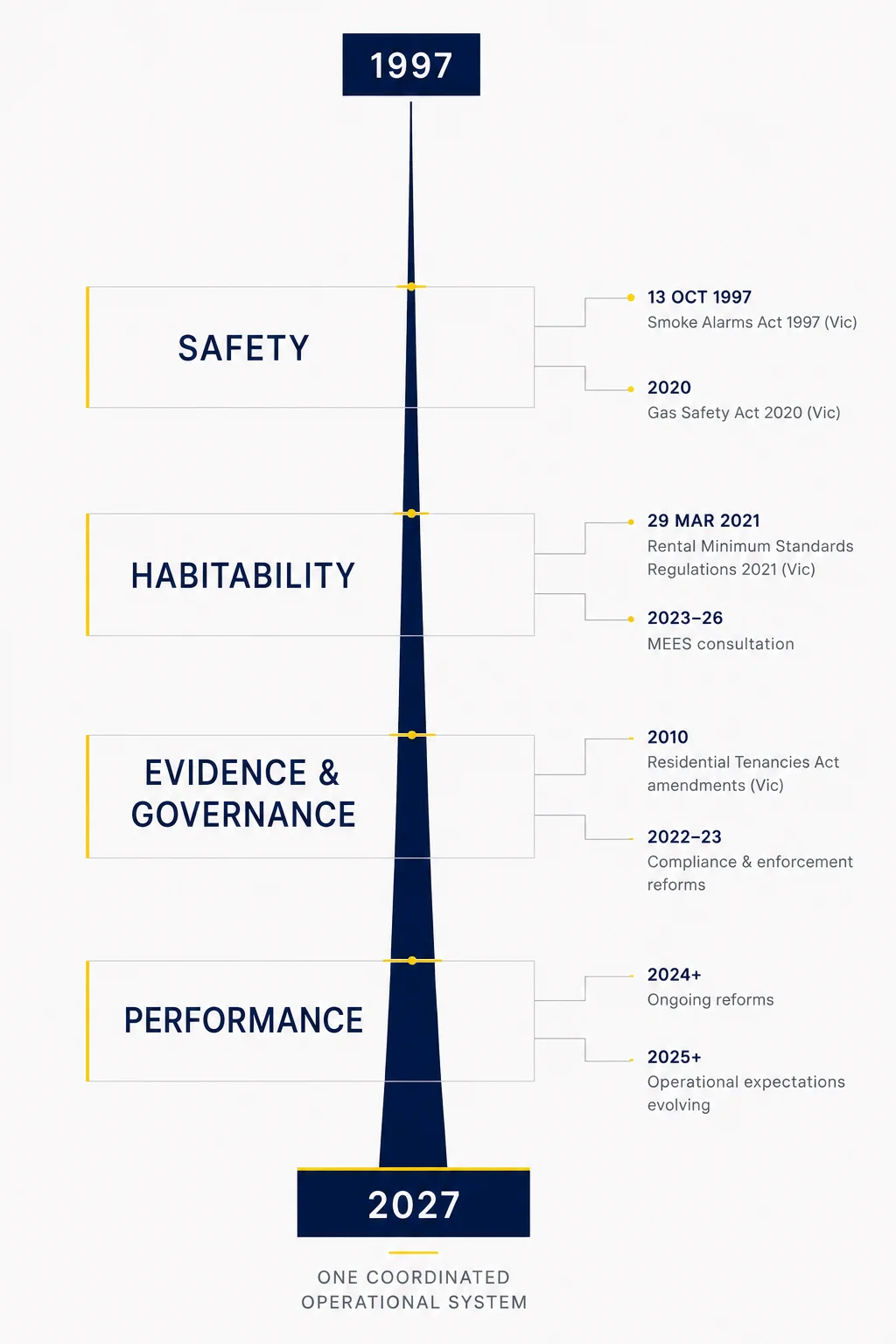
Over the past three decades, rental compliance has expanded beyond basic safety requirements to encompass housing quality, governance, operational performance and continuous improvement.
How Governments Are Redefining Good Housing
The evolution of compliance becomes much clearer when recent reforms are viewed together rather than in isolation.
The first wave of modern reforms focused on safety. Smoke alarms, gas safety checks and electrical inspections sought to reduce the risk of catastrophic events by ensuring critical building systems were regularly inspected and maintained.
Over time, the focus broadened to include habitability. In Victoria, Rental Minimum Standards introduced expectations around heating, security, ventilation, mould, kitchens, bathrooms and the overall condition of a property. Compliance was no longer concerned solely with preventing harm. It increasingly reflected the standard of home people were expected to live in.
At the same time, governments placed greater emphasis on evidence and governance, with property managers expected to retain inspection records, certificates and documentation demonstrating that compliance could be verified if required.
The next stage is already emerging. Victoria's Minimum Energy Efficiency Standards (MEES), commencing from 2027, begin extending compliance into performance. Requirements relating to insulation, efficient heating, hot water systems and draughtproofing recognise that the way a home performs has a direct impact on comfort, running costs and environmental outcomes.
A similar pattern is appearing elsewhere in Australia. The ACT has introduced minimum insulation requirements for rental properties. New South Wales is consulting on Minimum Energy Efficiency Standards for rental homes. Queensland has also strengthened minimum housing standards, including requirements relating to safety, security, weatherproofing, structural condition and functionality.
The detail differs by jurisdiction, but the direction is consistent.
Viewed individually, these reforms appear to address different problems. Viewed together, they reveal a change in how governments think about rental housing. Rather than regulating isolated risks, governments are increasingly concerned with the long-term performance of a critical piece of social infrastructure.
In much the same way governments maintain roads, schools and hospitals through ongoing standards, inspections, maintenance programs and lifecycle planning, rental housing is gradually being brought into a more structured framework of stewardship.
Compliance is becoming one of the mechanisms through which that stewardship is delivered.
A Global Shift in Housing Policy
Australia is not alone in broadening its expectations of rental housing.

New Zealand's Healthy Homes Standards require rental properties to meet minimum standards for heating, insulation, ventilation, moisture ingress and draught stopping. In the United Kingdom, the Decent Homes Standard and Minimum Energy Efficiency Standards similarly extend expectations beyond basic safety to include the condition, energy performance and overall quality of housing.
Although each country has developed its own regulatory framework, the direction of travel is remarkably consistent.
Rather than focusing solely on preventing immediate safety risks, governments are increasingly defining the broader standard of housing that people should expect when renting for the long term.
The reasons are also becoming increasingly familiar. Across many developed economies, housing affordability has declined, home ownership has become less attainable for younger generations and renting has become a longer-term form of housing rather than a temporary step towards ownership.
As those demographic shifts continue, governments are increasingly treating rental housing as essential social and economic infrastructure. That naturally places greater emphasis on the quality, resilience and long-term performance of the housing stock - not simply whether individual compliance obligations have been met.
Australia's recent reforms are best understood as part of that broader international shift, rather than as a series of isolated regulatory changes.
What This Means for Property Managers
There has also been a fundamental evolution of the profession. Traditionally, success was measured by the effective administration of a tenancy. Rent was collected on time, maintenance issues were resolved, vacancies were minimised and relationships between owners and renters were managed professionally.
Those responsibilities now sit alongside a broader set of expectations. Property managers are expected to coordinate compliance programs, oversee contractor networks, maintain accurate records, demonstrate legislative compliance, monitor asset condition and provide the governance needed to support increasingly complex housing portfolios.
At first glance, these responsibilities can seem like an ever-growing list of compliance obligations. In reality, they reflect a broader shift in what property managers are being asked to deliver: ensuring rental properties continue to meet the standards governments and the community increasingly expect from long-term housing.
For owners and housing providers, this means the value of a property is increasingly influenced not only by its location and market conditions, but also by how well it is maintained, documented and managed over time. Effective property management has become an important part of protecting both the performance of the asset and the risks associated with owning it.
That represents a significant evolution of the profession. Today's property managers are not simply coordinating tenancies. They are helping owners and housing providers protect the condition, performance and long-term value of housing assets while ensuring those homes remain safe, compliant and fit for the people who depend on them.
A New Standard for Property Management

Twenty years ago, compliance largely answered one question: Has the required task been completed? Today it answers a much broader one: Is this property being managed to the standard Australians increasingly expect from long-term housing?
That shift reflects far more than an expanding body of legislation. It reflects a changing understanding of rental housing itself. As more Australians rent for longer, governments are increasingly treating housing as critical social and economic infrastructure that supports public health, workforce participation, community wellbeing and long-term economic resilience.
For property managers, that changes the nature of the profession.
Success is no longer measured solely by collecting rent, coordinating maintenance or minimising vacancies. It is increasingly measured by the ability to protect the quality, performance and resilience of housing assets through effective governance, documentation, compliance and long-term stewardship.
Compliance is not replacing property management. It is redefining it.
And as Australia's expectations of rental housing continue to evolve, property managers will play an increasingly important role in protecting not only individual investments, but the quality and resilience of the nation's housing stock.
This shift also changes what organisations need from the systems that support them.
As expectations of rental housing continue to expand, compliance can no longer be managed through isolated inspections, spreadsheets or disconnected records. Organisations increasingly need connected information, clear governance and confidence that every property continues to meet an evolving standard.
That is why the conversation is moving beyond individual compliance activities towards portfolio oversight, asset stewardship and operational visibility. The challenge is no longer simply completing the next task. It is maintaining confidence that an entire housing portfolio continues to perform as expected.
Building the capabilities modern property management requires
If the role of the property manager is evolving, the systems that support it must evolve too.
Managing compliance, maintenance, asset information and governance as separate activities becomes increasingly difficult as portfolios grow. That's why Taskforce has developed a connected suite of capabilities that help organisations maintain confidence across every property they manage.
How Taskforce Supports Modern Property Management
As the expectations of rental housing continue to evolve, Taskforce helps property managers and housing providers maintain visibility across their portfolios through connected compliance, maintenance, asset management and operational governance. Tools include:
Compliance To-Do Lists
Asset Registers
Talk to our team
If you have questions about how our services may support you or would like to speak to someone about the challenges you're facing to meet requirements across your portfolio, contact our team using the form below. We'd love to hear from you.
Contact UsFrequently Asked Questions
Property management has become more compliance-focused because the expectations placed on rental housing have expanded. While compliance once centred on essential safety requirements, it now increasingly includes housing quality, documentation, governance, asset condition and energy performance. As more Australians rent for longer, governments are placing greater emphasis on ensuring rental homes remain safe, functional and fit for long-term occupation.