At a Glance
The challenge: Different pricing and repair inclusions made rental safety check services difficult to compare, prompting Taskforce to reconsider how its services were structured.
The opportunity: Straightforward repairs that previously required a separate job and return visit could often be completed during the original safety check.
The change: Taskforce equipped technicians and adapted its operational systems to complete more repairs onsite, supported by two service options: Saver and Plus.
The result: Approximately 200 return visits avoided in the first 15 weeks, with only 2.35% of safety checks generating a separate rectification job.
For property managers: Fewer separate repair jobs mean fewer quotes, owner approvals, appointments and follow-ups to coordinate.
Competition has a way of making businesses question things they've long taken for granted.
For Taskforce, pressure to make its safety check services more competitive meant going back to basics. Victoria's evolving market had produced a range of pricing and inclusion models, making it difficult for agencies to compare providers.
At the heart of that complexity was a fundamental question: was a safety check simply an assessment of a property's compliance, with repairs charged separately, or a more comprehensive service that included addressing the problems it uncovered?
Taskforce wanted to offer both options: a competitively priced safety check for agencies that preferred to pay for repairs separately, and a more comprehensive service that included common repairs within the price. The challenge was finding a way to deliver both efficiently, without creating unnecessary work for technicians, property managers or renters.
That prompted Taskforce to reconsider how safety checks and repairs were organised. If straightforward repairs could be anticipated and technicians equipped to complete them during the original attendance, why create another job and return visit?
Taskforce introduced its redesigned service in June. In the first 15 weeks, approximately 200 return visits that would previously have been required were avoided. That means fewer quotes, approvals and appointments for property managers to coordinate, fewer additional costs for rental providers and less disruption for renters.
Why Rental Safety Check Pricing Is Still Evolving in Victoria
Victoria’s rental safety check requirements created a new service category almost overnight. The checks themselves followed a relatively predictable model: annual smoke alarm checks and electrical and gas safety checks every two years, each with established procedures and reasonably foreseeable time and equipment requirements.
The greater complexity lay in what happened when those checks uncovered a problem. Unlike the checks themselves, rectification work varied considerably in scope, cost and complexity. Providers had to develop their own approaches to managing that work, including what could be completed onsite, what required a separate visit and how it would be charged.
Five years on, that model is still evolving.

Taskforce CEO Jason Bright points to Queensland, where the rental smoke-alarm compliance market has had considerably longer to develop.
“Providers have largely settled on the same subscription model,” he said. “But that's evolved over a much longer time than we've had here.
“The electrical and gas additions in Victoria added a lot of complexities that smoke alarms don't have. All of a sudden you've got lots of things that could need rectification. Some can be done at the time of the check, some can't.”
That complexity has contributed to different pricing and inclusion models across the Victorian market.
For property managers, the headline price of a safety check was only part of the picture. Identifying a fault could trigger a chain of additional quotes, approvals, charges and visits, as we explored in our previous article “Why safety check repairs create big admin for property managers”. Understanding what a provider included, and what would happen when something needed repairing, was essential to making a meaningful comparison.
Taskforce needed a clearer, more consistent model; one that distinguished between the cost of assessing a property's safety and the work required to bring it up to standard, while making the treatment of common repairs more predictable.
Completing More Safety Check Repairs in One Visit

Reconsidering those inclusions raised a practical question: which repairs could reasonably be completed during the safety check appointment time, rather than creating a separate rectification job?
Previously, Taskforce replaced smoke alarms onsite, while other straightforward repairs required a separate job and return visit. For Jason, recognising that more of this work could be completed during the original attendance was something of an 'aha' moment. A process that had long been taken for granted suddenly looked like an opportunity to do things differently.
Turning that opportunity into a practical change meant looking at the process from the technician's perspective. Which repairs were most commonly identified during safety checks? Which could realistically be completed within the time allocated? What parts and equipment could technicians reasonably carry? And what would need to change to support them?
“It wasn't just as simple as saying, ‘If you see a power point, change it rather than doing a quote.’ There was a lot of work behind the scenes that needed to be refined,” explained Jason. “There were app changes so technicians could record the repairs and that information then needed to flow through to invoicing, depending on whether the item was included or charged separately.”
The result was a defined list of repairs that technicians could reasonably complete during the original attendance. Supporting that change also required technician training, stock replenishment processes and systems capable of distinguishing between different service arrangements.
Alongside those operational changes, Taskforce had to develop and communicate the new pricing structure, explain what was included in each option and support agencies through the transition.
The Results: 200 Return Visits Avoided in 15 Weeks
In the first 15 weeks following the introduction of the new model, Taskforce completed 3,317 safety checks across its Saver and Plus services. Of those checks, 551 involved repairs completed during the original attendance, covering 987 individual items. These included smoke alarm batteries and replacements, light switches, power points and flue strapping.
Under the previous model, smoke alarm replacements were generally completed onsite, but other straightforward repairs required a separate rectification job. Comparing the new repair records
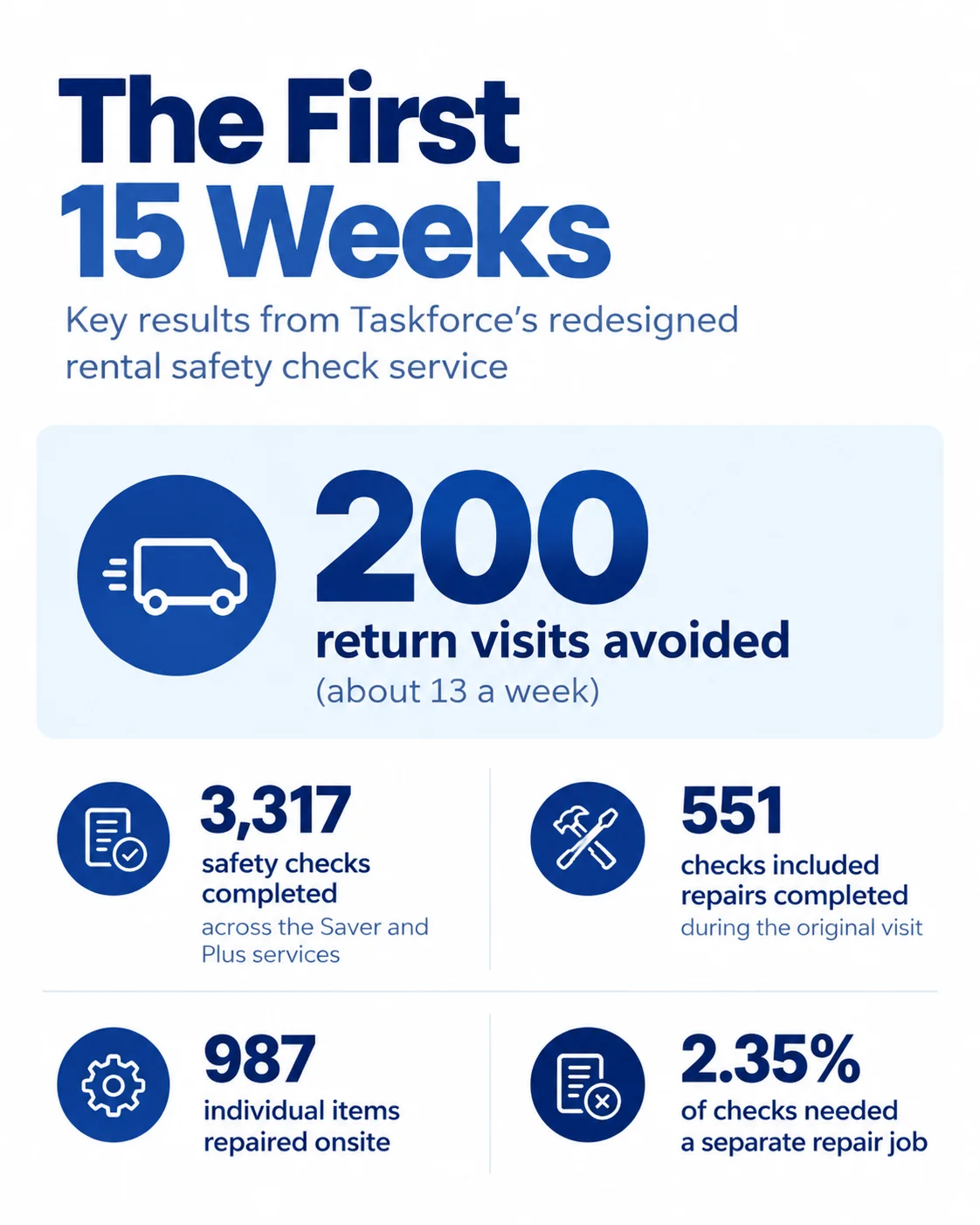
against that earlier approach shows that approximately 200 return visits were avoided in just 15 weeks; around 13 every week.
The checks themselves are still identifying problems. Around 20% required some form of repair, yet only 2.35% resulted in a separate rectification job.
For property managers, that difference has meaningful implications across a portfolio: fewer quotes to review, fewer owner approvals to obtain, fewer appointments to coordinate and fewer jobs to follow up. When work is completed while the technician is already at the property, property managers avoid much of the administration that would otherwise follow.
How Saver and Plus Handle Repairs
Both Saver and Plus allow eligible straightforward repairs to be completed during the original safety check without an additional labour charge. The difference is how those repairs are priced.
With Saver, eligible onsite repairs are charged separately at pre-agreed prices, giving agencies a lower upfront service cost. With Plus, a defined range of eligible repairs is included in the service price, providing greater cost certainty.
Under both options, repairs requiring a separate visit are quoted and charged separately.
Reducing the Work Behind Rental Safety Compliance

Compliance is one job on a long to-do list for property managers. The trouble starts when that one job suddenly multiplies into many if a property doesn't meet the required standards.
An owner needs to approve the repair, but isn't answering the phone. The tenant can't accommodate the proposed appointment. The keys aren't where they're supposed to be. Meanwhile, the repair is still outstanding, the documentation needs updating and someone has to keep track of it all.
Multiply that across a portfolio and even relatively minor repairs can create a substantial administrative burden.
For Taskforce, the breakthrough came from recognising that some of those additional tasks didn't need to exist in the first place. Rather than accepting the established process, it questioned why a straightforward repair should become a separate job at all.
“Sometimes you need to step back and challenge the things you do just because that's the way everyone does them,” Jason reflects.
Talk to our team
If you have questions about how our services may support you or would like to speak to someone about the challenges you're facing to meet requirements across your portfolio, contact our team using the form below. We'd love to hear from you.
Contact UsFrequently Asked Questions
Got questions? We have answers.
Yes. Taskforce's Saver and Plus services allow eligible straightforward repairs to be completed during the original safety check, provided the technician has the necessary parts and sufficient time. More substantial repairs may still require a separate visit.