In Brief
Large asset owners have found cost advantages in moving away from reactive repairs towards planned maintenance.
Organised knowledge across large portfolios makes maintenance costs easier to anticipate, giving businesses greater confidence to allocate capital elsewhere.
Building an accessible history for an asset provides better evidence for decisions about what to repair, replace or invest in next.
Housing providers can now access some of these same advantages without needing the scale or resources of a major commercial asset owner.
Recent reviews (Homes Tasmania, WA Auditor General and Victorian Auditor General for example) have raised questions not only about the resources available to the social and community housing sector, but also the systems and information needed to use those resources effectively.
Other asset-intensive sectors have spent decades addressing some of the same operational questions from a very different starting point. Airports, shopping centres and large commercial property portfolios have generally had access to substantially greater private capital and specialist resources to manage thousands of assets across long periods of time.
That investment has allowed many of these organisations to develop sophisticated systems for balancing maintenance, compliance and capital expenditure, and for connecting what happens to an asset today with decisions about what happens to it next.
Social and community housing does not operate with the same resources. But increasingly, it may not need to replicate the same level of investment to benefit from some of the principles those systems have established.
As technology makes connected property information more accessible, there is value in looking at what resource-rich asset owners have learned and which of those advantages can now be applied within the very different operating environment of social and community housing.
Melbourne Airport: intervening before failure dictates the response
Failure cannot always be predicted or prevented, but an asset shouldn't have to fail before it attracts attention. Between performing as expected and failing altogether, changes in condition, repair history and performance can provide useful signals about what may be needed next.
Take Melbourne Airport's Pavement Management Plan, for example. The consequences of sub-standard pavement can be significant ranging from runway or taxiway closures to loose material being ingested by aircraft engines.

Each year, as part of its wider asset-management planning, the airport's airfield pavements undergo technical inspection, assessing their condition and identifying capital requirements over one, three and ten-year horizons.
Intervention ranges from routine work such as crack sealing and localised repairs to replacing individual concrete slabs and undertaking structural reconstruction.
The results are tangible: Melbourne Airport says many of the original concrete taxiways and apron areas installed when the airport opened remained in service beyond their 40-year theoretical design life, attributing that longevity to comprehensive maintenance practices.
The value of intervening before assets reach their worst condition is also evident elsewhere in Victoria's transport network. In its review of road maintenance, the Victorian Auditor-General found that VicRoads' reactive “worst first” approach, prioritising roads in the poorest condition, was not improving the overall condition of the pavement network and was not designed to achieve the lowest whole-of-life cost.

The audit cited research showing that an optimised maintenance program could produce better overall road condition at lower cost over 20 years than continuing to fix the worst roads first.
Roads, runways and homes are very different assets, but the underlying principle is relevant to social and community housing. An asset does not need to be either performing normally or in failure. Condition can change gradually, creating opportunities to recognise deterioration and intervene before the problem becomes more serious or expensive.
The importance of understanding that condition is already well established in housing. The Victorian Auditor-General has previously found that comprehensive and accurate property-condition data is necessary to understand maintenance requirements and inform decisions about upgrades, redevelopment and other investment across the public housing portfolio.
A repair still needs to solve today's problem. But retaining what that repair reveals, alongside asset age, condition, previous failures and interventions, can also help determine whether another repair remains appropriate, whether replacement should be planned and where future investment may be required.
Vicinity Centres: how maintenance certainty supports better forward planning
Knowing what an asset needs is only part of forward planning. An organisation also needs enough visibility over its future expenditure to decide what it can afford to do about it.
At Vicinity Centres, each shopping centre has a Vision, Strategy, Action plan setting out the plans, programs and projects for that asset. Those plans are also used by Vicinity's Investment and Capital Committee when allocating capital across maintenance, amenity and sustainability upgrades, tenant reconfigurations and larger investments.

Bringing those competing demands into the same investment view gives Vicinity greater scope to consider where capital will be most useful, rather than approaching each category of expenditure in isolation. Maintenance can be weighed alongside planned upgrades and larger interventions, with decisions made in the context of what else is intended for the asset.
For social and community housing providers, the value of forward planning is already well understood. The harder part is maintaining that forward view amid constrained budgets, workforce pressures, competing investment priorities and the immediate needs of residents. Uncertainty around responsive maintenance adds another pressure: when the cost of what might fail next is difficult to predict, there is less certainty about what can safely be committed elsewhere.
The balance between reactive and planned expenditure has been a longstanding issue in public housing. In 2017, the Victorian Auditor-General reported that a government-commissioned review had recommended a 70:30 split between planned and responsive maintenance. In Victoria, however, planned maintenance accounted for only 42 per cent, which the Auditor-General concluded was not cost-efficient.
Interestingly, part of the problem was the way maintenance was bought. The existing contracts did little to encourage contractors to think beyond fixing problems as they arose. DHHS was therefore considering a different model: giving a contractor responsibility for a group of properties, with incentives to keep them at an agreed standard over time.
More recent evidence suggests the challenge remains. In 2025, the Western Australian Auditor-General reported that 85 per cent of housing maintenance was reactive, while maintenance costs had risen 44 per cent since 2019. The report also helps explain why that balance matters. Planning work ahead creates opportunities to group jobs, reduce administration and make better use of trades. It also cited research suggesting reactive maintenance can cost 50 per cent more than planned work, with the gap increasing when repairs become emergencies.
The findings are useful because they show that maintenance models aren't financially neutral. How work is contracted can influence whether the system encourages reactive repairs or supports a more planned approach to the asset.
This brings us back to the advantage visible at Vicinity. Its scale and operating model allow maintenance to sit within a wider, forward-looking view of the asset, where it can be considered alongside upgrades, reconfigurations and other calls on capital. Housing providers may not have the same resources or operating structure, but the question is whether different maintenance models can give them more of that planning advantage.
Subscription maintenance offers one possible approach. It cannot make maintenance completely predictable, nor remove the need to respond to unexpected failures, but where defined maintenance activity can be provided at an agreed cost, more of the maintenance requirement becomes known in advance.
That potentially creates two advantages: greater visibility over future maintenance expenditure and greater scope to organise maintenance as an ongoing portfolio requirement rather than simply responding to individual jobs as they arise.
Neither replicates the scale of a major shopping-centre owner. But both can give housing providers more of what that scale makes possible: the ability to look ahead, coordinate work and make decisions about scarce resources with a clearer view of the competing needs of the portfolio.
Mirvac: turning operational experience into asset knowledge
Build-to-rent provides an interesting comparison for housing because its operating model can connect stages of the property lifecycle that are often managed separately.
Mirvac is a useful Australian example. Its wider business spans development, construction, investment and asset management, while its LIV build-to-rent model extends into the ongoing management of completed properties.
That means the relationship with an asset doesn't necessarily end once it has been designed and delivered. Operating it creates another source of information.
For example at LIV Indigo, Mirvac's first large-scale build-to-rent development, day-to-day operations created a new source of insight into how the property worked in practice. Mirvac has applied what it learned from residents, repairs and operating its early LIV communities to subsequent developments. When LIV Albert opened in Melbourne, CEO Campbell Hanan described it as the product of more than five years of operating LIV communities and listening to customers.

The lesson for housing isn't that every provider needs to control the entire property lifecycle. It's that operating a property produces knowledge that can make the next asset decision better. Housing operations generate this kind of intelligence constantly. A repeated repair can reveal a component that is performing poorly. Recurring faults across similar properties can point to a wider issue. Resident reports, safety checks, replacements and maintenance histories all add to what is known about how assets perform in use.
The challenge is making that knowledge cumulative and visible. If the information remains within individual jobs, emails or maintenance records, the immediate problem may be resolved without adding much to the organisation's understanding. When it remains connected to the property, each intervention can add context to the decisions that follow.
Housing providers do not need Mirvac's vertically integrated structure to apply that principle. The opportunity is to create the information connection organisational integration gives Mirvac naturally: allowing what is learned through residents, maintenance and compliance to contribute to the longer-term understanding of the property and, over time, the wider portfolio.
What can housing take from these models?
Airports, shopping centres and build-to-rent operate under very different conditions from social and community housing. They have different sources of capital, different obligations and, in many cases, considerably greater resources. The useful comparison isn't the scale of their operations, but what that scale has allowed them to do.
Across the three examples, three capabilities stand out:
Understand what is happening to the asset: Condition, performance and maintenance history can help identify when intervention may be needed, rather than waiting for failure to dictate the response.
Create enough forward visibility to plan: Greater certainty around maintenance expenditure makes it easier to consider maintenance alongside other priorities for the asset.
Make operational knowledge cumulative: What is learned through repairs, compliance and day-to-day operations can remain connected to the property and inform future decisions.
Historically, developing those capabilities required considerable organisational infrastructure. Large asset owners could employ specialist teams, build sophisticated asset-management systems and create operating models that connected maintenance, operations and longer-term investment.
Housing providers do not need to replicate those organisations to access the same principles. The opportunity is to use recent technological advances to make some of these advances of scale more accessible within the very different constraints of social and community housing.
Bringing the principles into housing maintenance
The advantages in these examples have traditionally depended on scale: enough information to understand how assets behave and enough visibility over maintenance requirements to plan beyond the next repair.
Taskforce applies those principles to housing in two practical ways.

Subscription maintenance is designed to reduce maintenance costs over time while making those costs more predictable. Taskforce's pricing draws on historical maintenance expenditure across multiple property portfolios to understand what properties actually cost to maintain. That evidence is used to establish an annual per-property price below those average maintenance costs.
This gives housing providers two advantages: a lower maintenance cost based on historical experience, and greater visibility over what they will spend. That visibility makes it easier to plan maintenance alongside replacements, upgrades and other competing priorities across the portfolio.

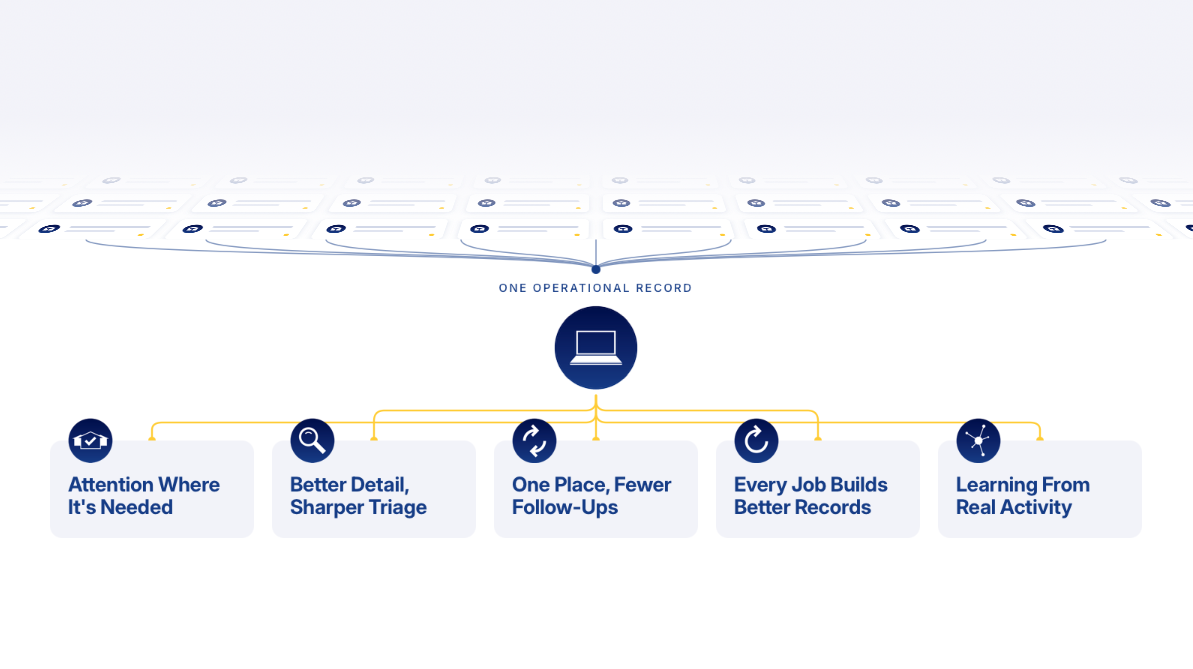
Connected asset registers create similar continuity around information. Repairs, safety checks and other interventions become part of the property's ongoing record, building a clearer picture of condition, performance and maintenance history over time. What is learned through day-to-day operations can then inform what happens next.
Together, the two approaches create greater continuity around maintenance: a clearer view of what the portfolio is likely to require financially and a better understanding of what individual properties may need next.
Talk to our team
If you have questions about how our services may support you or would like to speak to someone about the challenges you're facing to meet requirements across your portfolio, contact our team. We'd love to hear from you.
Contact UsFrequently Asked Questions
Commercial asset managers demonstrate the value of understanding asset condition, planning maintenance expenditure ahead and retaining operational information over the life of an asset. While housing operates under very different financial and social conditions, these principles can support better-informed maintenance and asset decisions.