At a glance
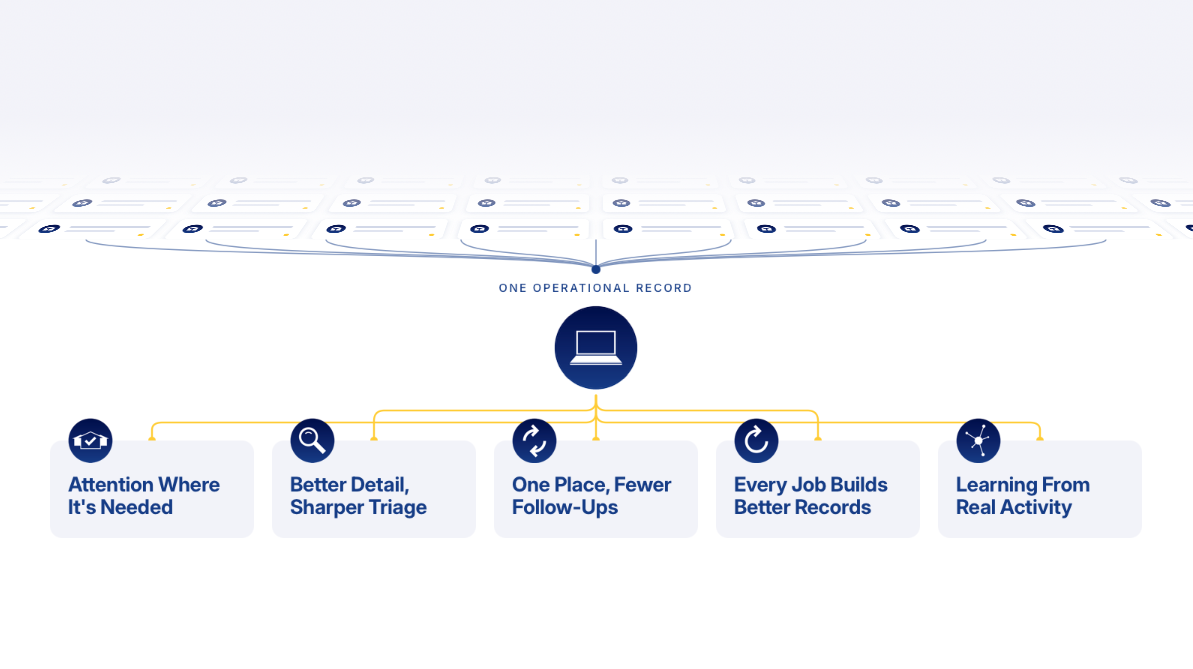
At scale, maintenance becomes less about managing individual jobs and more about knowing where attention is needed next.
Better information at triage can prevent unnecessary call-outs, improve prioritisation and help direct work to the right trade.
Connecting job status, scheduling and property information reduces the follow-up traditionally required to understand where work is up to.
Every completed job can strengthen the property record, turning maintenance history into useful information for assurance, planning and future decisions.
Nearly 700 jobs in, real service activity is also shaping Domera itself, allowing operational lessons to feed directly back into how the system develops.
What We've Learned From 700 Maintenance Jobs
Six weeks and nearly 700 maintenance jobs in Domera, Taskforce’s new digital operating environment for coordinating property and maintenance information, is beginning to show what it can do under real service conditions.
Most encouraging is Domera’s management of complexity: separating signal from noise, identifying what is urgent, what information is missing, who needs to act next and where intervention is required.
And with every job, we're learning more about how Domera can further strengthen the way maintenance is coordinated and delivered.
Read on for the real maintenance scenarios showing where Domera is already reducing complexity, focusing attention where it's needed, and improving decision-making.
Tracking Maintenance Jobs Without The Guesswork

The difficulty Taskforce identified when developing Domera is that maintenance jobs don't form an orderly queue. They pull attention in different directions at once: one needs more information, another is waiting for approval, a trade is closing out a third while a new urgent repair has just arrived. At scale, maintenance stops being a linear process and becomes a constant exercise in knowing where attention is needed.
For housing providers, that same complexity often appears as uncertainty. A job has been lodged, but where is it up to? Too often, answering that question creates another email, phone call or follow-up simply to establish whether the work is moving forward.
Domera changes that by connecting the housing provider's view of the job with the operational system Taskforce uses to progress it behind the scenes. Providers can follow how work is progressing, while the Taskforce team focus its attention on the jobs that actually require intervention.
Consider a resident reporting their heating has stopped working.
The request is entered by either the housing officer or tenant (via a maintenance request form or QR code) into Domera and appears in Taskforce's operational CRM for triage. Before a trade is sent, the team may need more information: What exactly has failed? Is there an error showing? Can the resident send a photograph? That request can be sent to the resident from the system directly by SMS, with the reply retained against the job.

From there, the CRM dashboard does something important: it continuously scans jobs for updates and re-prioritises them based on their current state, incoming information and required timeframes, rather than presenting staff with a static to-do list.
In the heating example, where the team is waiting on information from a resident, the job can sit in that waiting state without demanding constant attention until the resident replies or a set timeframe is reached. At that point, the job returns to the team's action queue, signalling that intervention is required again.
The same principle applies across the job's lifecycle. A quote requiring review, a job needing allocation or work approaching an SLA deadline can all be brought back into focus when action is required.
That last point is particularly important. Housing maintenance operates against defined response requirements, with registered housing agencies measured on the timely completion of urgent and non-urgent repairs. But knowing a deadline exists is very different from being able to organise hundreds of live jobs around it.
By weighing the required timeframe alongside the job's current status and next action, Taskforce’s system can bring work forward before the deadline itself becomes the problem. An SLA therefore becomes more than a due date stored against a job; it becomes part of the logic determining where the team's attention needs to go next.
The result is a much simpler operating rhythm: act where action is needed, let the rest keep moving and bring it back into focus when the next decision is required, all while giving housing providers visibility.
Directing attention more deliberately reduces the amount people need to mentally carry, lowers the risk of important work being obscured by routine noise and creates more capacity for the unusual, urgent or high-consequence issues that genuinely require human judgement.
Better Coordination Reduces Avoidable Cost

Better coordination helps direct maintenance spend towards the intervention actually required, rather than the first response that seems available.
Take a blocked toilet. The obvious response is to send a plumber, but the right response depends on the circumstances: is it the only toilet in the property, is it overflowing, are other facilities still available?
A few extra pieces of information can materially change what happens next. They may confirm that urgent attendance is required, change the priority or trade needed or show that the issue can be resolved without an unnecessary contractor call-out.
The same principle applies after a trade has been allocated.
A resident calls because their trade hasn't arrived. Traditionally, answering that question can create another chain of activity: contact the trade, establish where they are, work out the likely arrival time and call the resident back.
With the connected scheduling environment, Taskforce's support team can see the trade's current schedule from the office and, where appropriate, adjust the timing of the visit without starting another round of calls and coordination.
If a resident suddenly needs to leave the property, for example, the team can see where the appointment sits in the trade's day and move it to a later time if the schedule allows.
That turns what would traditionally be a coordination problem into a scheduling decision.
A further Domera upgrade is also being developed to give housing providers and residents that same insight directly, allowing them to see a trade's location and expected arrival.
Domera has already shown how a small piece of operational insight can remove an entire chain of coordination. For housing providers, that has a direct cost implication: fewer unnecessary call-outs, less repeated follow-up, fewer misallocated trades and better-informed decisions before work is dispatched.
For residents, that same insight means quicker answers and greater certainty. For housing teams, it means less time spent chasing the process and more confidence that the process itself is under control.
Matching the Right Trade to Every Maintenance Job
Once a job has been triaged, the next challenge is finding the trade best placed to complete that job within the required timeframe.
The operational system helps Taskforce narrow that decision by identifying relevant trades for the work, rather than leaving the team to start from a directory and work through it manually.

That becomes increasingly valuable at volume. The decision is no longer simply: Who can do plumbing? It is: Who is suitable for this job, in this area, and able to meet the timeframe?
Once allocated, the trade receives the job through the Taskforce Tradie app, along with the information already gathered around it.
That context matters. A work order may describe the repair, but a successful visit can depend on knowing much more about the property: how to gain access, where relevant services are located, what has happened there previously or anything else the trade needs to know before arriving.
Because that information sits in the Domera property record rather than disappearing into individual conversations, it does not need to be rediscovered and re-explained every time someone attends.
The trade then records the completed work through the app, returning the completion information into the same connected environment and adding to the property's operational history.
The result is that allocation becomes more than sending a job to a contractor. The system helps connect the right trade with the context they need to arrive prepared, while each completed visit leaves better information behind for the next one.
Every Job Can Make the Property Record More Useful
Every maintenance job creates information. On its own, that information may solve a single problem. Retained and connected over time, however, it becomes something more valuable: a growing operational record of the property itself.
That is one of the most important ideas behind Domera. The more maintenance, compliance and completion information that accumulates around a property, the more useful that record becomes for the decisions that follow.
Maintenance jobs, resident information, compliance records and completion evidence can all accumulate around that property, building a more useful operational history over time.
That matters because housing maintenance generates large volumes of information, much of it is scattered across emails, conversations, photographs, reports and individual job records. When the next issue arises, teams can end up reconstructing the history from scratch.
Domera is designed to change that.

As each job moves through the system, the information it generates becomes part of the property record. Previous repairs, recurring issues, completion reports and related compliance information can then provide context for the next decision.
A housing provider could use the accumulated history to demonstrate what work was completed and when, support audit and reporting requirements, understand recurring maintenance patterns and compare activity across properties or parts of the portfolio. As the record becomes richer, it also creates the foundation for more forward-looking questions: which assets are generating repeated interventions, where costs are concentrating, what components may be approaching failure and where planned action could prevent another reactive job.
That is where property information starts to become a strategic asset rather than simply a record of past activity.
The value is cumulative. Each completed job adds another data point, making the property record more useful for assurance today and potentially more useful for planning and future decision making.
How Domera Improves With Every Maintenance Job
One of the most encouraging things about Domera's first six weeks is how quickly real maintenance activity is feeding back into the system itself.
General housing maintenance is extraordinarily varied. Taskforce Director of Housing, Damon Hill, describes requests ranging from taps and toilet blockages to trees requiring arborist reports. No operating model can anticipate every situation before it encounters the work. What matters is how quickly it can respond when something new appears.
Because Taskforce operates the maintenance service and develops the systems supporting it, the feedback loop is unusually short. When the operational team identifies something that could work better, that requirement can move directly into development.
Damon says the team distinguishes between “nice to have” improvements and changes essential to service delivery, with some must-have requirements producing a substantially developed solution within 24 hours.
A real job reveals an opportunity. The people doing the work identify what would improve it. The development team responds and that improvement can return quickly to live service delivery.
The system isn't being developed beside the work. It's being developed by the work.
Six weeks and nearly 700 jobs in, that may be one of Domera's most important strengths. The system is already helping Taskforce manage complexity more deliberately, while every new job provides another opportunity to make the operating model stronger.
See Domera in action
Nearly 700 maintenance jobs have given us an early view of what Domera can do. A demonstration is the easiest way to see how it could work across your own housing operations.
Call the Taskforce team to arrange a demonstration.
Talk to our team
If you have questions about how our services may support you or would like to speak to someone about the challenges you're facing to meet requirements across your portfolio, contact our team using the form below. We'd love to hear from you.
Contact UsFrequently Asked Questions
As maintenance volumes increase, the challenge is no longer simply progressing individual jobs. Teams need to know which jobs require attention, what information is missing, who needs to act next and which work is approaching required response timeframes. Without a connected operating environment, much of that coordination can depend on emails, phone calls and manual follow-up.